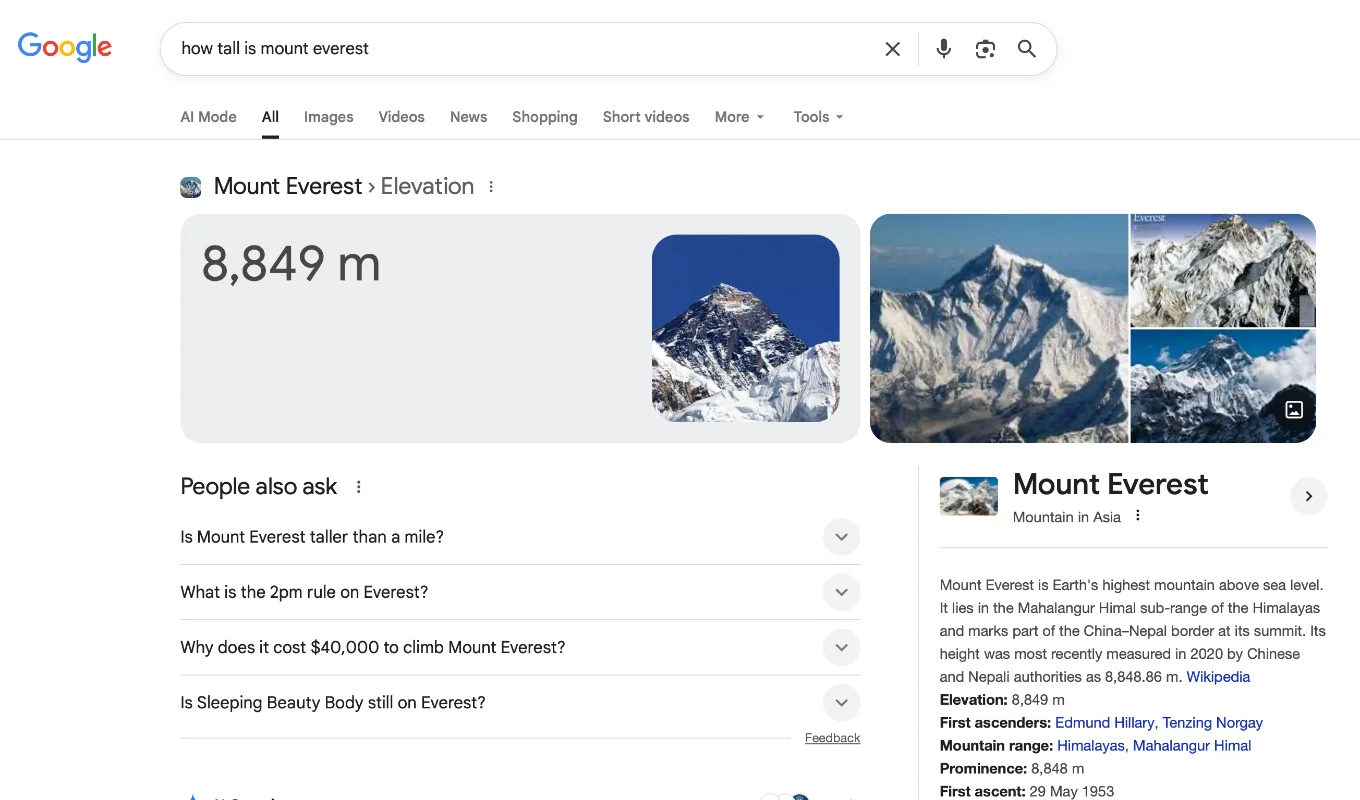

The first time a client asked me why their organic traffic was down but their phone hadn’t stopped ringing, I didn’t have a clean answer. It was late 2024. A Penrith-based accountant. Organic sessions had dropped roughly 40% year-on-year, but enquiries were steady. We pulled up Search Console. Impressions were up. Clicks were down. People were searching, finding the answer at the top of the page, and never clicking through.
That was the shape of things to come. By 2026, every small business I work with has the same chart. Impressions climbing. Clicks flat or falling. AI Overviews answering the question above the fold. ChatGPT and Perplexity citing pages without sending visitors.
Google didn’t stop being a search engine. It started being an answer engine as well. So did ChatGPT. So did Perplexity. So did Gemini and Copilot and the rest. And the work of getting your business in front of buyers has shifted to match.
This post is what I tell clients when they ask what’s changed and what to do about it. It covers what answer engine optimisation actually is, how it differs from the SEO you’ve been doing for years, what zero-click search means for a small UK business, and the practical steps I use to get small business pages cited inside AI answers.
TL;DR
- Answer engine optimisation (AEO) is the practice of structuring your content so AI-driven search tools – Google’s AI Overviews, ChatGPT, Perplexity, Gemini, Copilot – pick your page as the source of the answer they give the user.
- Google search hasn’t disappeared. It’s added an answer layer on top. Most informational queries now show an AI-generated summary above the blue links, and a large slice of users never click through to the source pages.
- Zero-click search is the term for that behaviour. For UK small businesses, it means visibility is no longer measured purely in clicks. Citation in the answer matters too.
- AEO vs SEO isn’t a replacement – it’s a layer. SEO gets you indexed, ranked, and considered. AEO gets you cited inside the AI answer. You need both.
- AI engines pick sources differently from classic Google. They favour pages with clear question-and-answer structure, specific named entities, original data, and credible authorship.
- Getting featured in ChatGPT and Perplexity answers comes down to four things: clear formatting, factual specificity, citations of named sources, and being mentioned by other trusted sites.
- “Search everywhere optimisation” is the broader idea – Google, Bing, ChatGPT, Perplexity, Reddit, YouTube, LinkedIn. Most small business buyers research across at least three of these before they buy.
- For most UK small businesses in 2026, the practical AEO list is shorter than it looks: question-led headings, direct first-sentence answers, FAQ schema, named author bios, original data or worked examples, and getting cited in places AI engines crawl.
- A real worked example below: a Hexham-based veterinary practice winning ChatGPT and Perplexity citations for “how often should I worm a puppy UK” by rewriting one page around the question structure AI engines prefer.
- Common mistakes: chasing AI traffic before fixing crawlability, stuffing pages with FAQ blocks that don’t match real queries, and treating AEO as a swap-out for SEO rather than a layer on top of it.
How has Google search changed for small businesses?
Three things changed at once between 2023 and 2026, and the cumulative effect is what most small business owners feel as “the SEO playbook stopped working”.
One: Google added AI Overviews to most informational queries. A user searching “how do I write a meta description” now sees a generated answer at the top of the page, citing two or three sources, before any blue link appears. If the answer satisfies the question, the user moves on. Click-through rates on positions 1 to 3 dropped accordingly.
Two: ChatGPT, Perplexity, Gemini, and Copilot etc became real research tools. They’re not novelties any more. UK users – business owners, marketers, professionals – research suppliers, services, and products through them. They ask “best London family solicitor for cross-border divorce” and read the answer, including the cited sources.
Three: Google’s classic ten blue links got pushed further down the page. Ads, AI Overviews, People Also Ask, video carousels, local pack, image pack. By the time a desktop user reaches the first organic result, they’ve often scrolled past the fold. On mobile, the first organic blue link can sit two or three swipes down.
The combined picture: Google still drives the largest share of search traffic to most UK small business sites. But the share is shrinking, the click-through rates on top positions are softer than they were, and a growing minority of buyers research through AI engines instead.
That’s the change you’re feeling. It’s not your imagination. The Penrith accountant wasn’t ranking worse – Google was answering more queries above the page itself, and his page was being read inside the answer rather than visited.
Is Google becoming an answer engine?
Yes – but it’s not stopping being a search engine.
The cleaner framing: Google has added an answer layer on top of the search layer. The search layer is still there. You can still rank for “Liverpool accountant” and pick up phone calls. What’s new is that informational queries – the “how do I”, “what is”, “why does my” questions – now resolve at the answer layer for a large share of users.
The shift is uneven. Transactional queries (“buy black trainers size 9”, “book a plumber Hackney”) still behave like classic search. Local-intent queries (“dentist near me”) still surface the map pack. Brand queries (“fecking creative pricing”) still return the website at the top. The AI answer layer hits hardest on informational, research-stage queries – the top of the funnel.
For a UK small business, the practical implication: your transactional and local pages still need classic SEO. Your educational and informational pages now also need answer engine optimisation, because that’s where the queries are being answered at the AI layer.
What is answer engine optimisation?
Answer engine optimisation is the practice of structuring your content so AI-driven search engines – Google’s AI Overviews, ChatGPT, Perplexity, Gemini, Microsoft Copilot – choose your page as a source when they generate an answer.
Two halves to it, same as classic SEO.
The first half is getting picked. AI engines select sources by reading and ranking pages much the same way Google does – crawlability, page authority, topical relevance – with extra weight on structural and credibility signals: clear questions and answers, named authors, citations, original data, schema markup, mentions across other trusted sources.
The second half is getting cited cleanly. Once an AI engine reads your page, you want it to lift a clean, attributable sentence from your content with your brand or domain alongside it. That’s the citation. Most users won’t click through, but the citation puts your name inside the answer they’re acting on.
AEO is a layer on top of SEO, not a replacement. Pages that rank well on Google are far more likely to be cited by AI engines, because the engines pull from a set of pages they’ve already deemed credible. Skipping the SEO foundations to chase AEO is a fast way to do neither well.
I first heard the term Answer Engine Optimisation way back in 2018 at Brighton SEO. Jason Barnard argued that Google had evolved from a Search Engine to an Answer Engine, and SEO needed to evolve. This was long before AI Overviews and people searching on AI Platforms for answers.
AEO vs SEO - what changes, what stays the same
Most of SEO still applies. The fundamentals – crawlability, fast pages, useful content matched to search intent, internal linking, backlinks, schema – are the foundations AEO sits on top of. Cut those out and AEO has nothing to work with.
What changes is the emphasis.
| What | SEO | AEO |
|---|---|---|
| Goal | Rank in the blue links | Be cited in the answer |
| Primary signal | Links, content quality, technical health | Structure, specificity, credibility, named entities |
| Format that wins | Long-form, well-organised pages | Direct, question-answered-in-one-paragraph blocks |
| Page-level KPI | Clicks, position, impressions | Citations, mentions, AI answer share |
| Time to result | Weeks to months | Days to weeks (the citation can appear fast) |
| What kills it | Thin content, broken pages, no backlinks | Vague answers, no schema, no author, walls of text |
The shift in writing style matters more than people realise. SEO content typically buries the answer in paragraph three after some setup. AEO content puts the answer in the first sentence under the question heading, then expands. The structural difference is what AI engines pick up cleanly.
I rewrote a Hexham-based vet’s “how often should I worm a puppy UK” page in February 2026 from a 1,400-word narrative into a 1,400-word question-answer structure. Same word count, same accuracy. Within three weeks the page was being cited in ChatGPT and Perplexity answers for the query and three of its long-tail variations. The page itself didn’t get a big traffic lift, but the practice’s enquiries about puppy plans went up – people were reading the citation, then searching the practice name.
AI search vs traditional search - how they actually work
Traditional Google search matches a query to a set of ranked pages. The user picks which page to visit. Google’s job is to surface the right pages.
AI search matches a query to a generated answer, with citations to the pages the answer was built from. The user usually reads the answer instead of visiting the pages. The AI engine’s job is to assemble a reliable answer and attribute it to its sources.
The mechanism inside an AI engine is different from a search index lookup. Most AI search tools use retrieval-augmented generation: they search a live or recent index for relevant pages, read the top results, then have a language model write an answer using those pages as input. The language model is choosing which sentences and facts to include in the final answer.
That changes what wins.
- Specific facts win over vague claims. “UK puppies should be wormed every 2 weeks until 12 weeks old, then monthly until 6 months” beats “puppies should be wormed regularly”.
- Clear question-answer structure wins over flowing prose. The model can lift a clean sentence pair more reliably than it can summarise a paragraph.
- Named sources and citations inside the page win. AI engines prefer to cite pages that themselves cite credible sources – it suggests rigour.
- Authored content wins over anonymous content. Pages with a named, credentialed author are favoured because the model treats authorship as a credibility signal.
Optimising for AI search in the UK means writing for those four preferences without losing the things that make a page work for human readers. Done well, the two pull in the same direction. Done badly, the AEO version is robotic and the SEO version is unfocused.
Zero-click search: what does it mean for my business?
Zero-click search is the term for a search where the user gets the answer without clicking through to any of the source pages. Featured snippets did this first. AI Overviews and AI engines do it on a much wider scale.
For a UK small business, three practical implications follow.
1. Your click-through rate on informational queries will keep dropping. That’s the headline data point. Pages ranking 1 to 3 on Google in 2026 see roughly 20–40% lower CTRs than they did in 2023 on queries where AI Overviews now appear. That’s a real loss of traffic, and it’s not coming back through better rankings.
2. Brand visibility starts to matter more than traffic. If your brand shows up inside the answer – cited, named, linked – the user has heard of you even without a click. That counts. They search the brand name later. They mention it to a colleague. The downstream effect shows up in branded organic traffic, direct traffic, and stronger close rates on enquiries that mention “I saw you in…”.
3. You need to track new things. Impressions, position, and click-through are still useful. You also need to track AI citation: how often your domain appears in ChatGPT, Perplexity, Gemini, and AI Overview answers for your target queries. Tools like Profound, Goodie, and Otterly track this. Manual checks across the four big AI engines for a sample of target queries work too if you don’t fancy another tool subscription.
A small business with 2,000 monthly Google sessions in 2023 might be doing 1,500 monthly sessions in 2026 – but be cited 30 times a month inside AI answers. That’s not the same business. The 30 citations are reaching a different layer of buyer – research-stage, curious, often higher intent than the 2023 click-through traffic.
How to optimise for answer engines UK - the practical list
Here’s the shortlist I use on small business sites. Six items. Done in this order, they’ll lift AI citation share inside 6–12 weeks.
1. Question-led page structure. Every important page should have its top headings written as the question a real user would type. “What is answer engine optimisation?” not “Introduction to AEO”. Use Search Console queries, People Also Ask, and AlsoAsked to find the actual phrasing.
2. The answer in the first sentence under the heading. Direct, factual, complete. The first sentence should be the citable sentence. The rest of the section expands and supports it. AI engines lift the first sentence under a question heading more often than any other.
3. FAQ schema and Article schema, applied properly. Schema markup tells engines what your page contains. FAQ schema in particular signals question-answer pairs to AI search tools. Don’t fake it – use FAQ schema only on actual question-and-answer content that matches real queries.
4. Named author with a credentialed bio. An “Author: Stephen Little, owner of fecking creative, 18+ years in UK search” line plus a linked author profile page is worth more than five hundred words of generic copy. AI engines treat authorship as a strong credibility signal.
5. Original data, worked examples, or named case studies. AI engines prefer pages with content that doesn’t appear anywhere else. A “we surveyed 47 UK accountancy firms in March 2026 and found…” block is gold. So is a worked example with real numbers — the Hexham vet, the Ambleside holiday cottage, the Dumfries dentist.
6. Mentions in places AI engines crawl. Reddit threads, YouTube transcripts, LinkedIn posts, industry publications, podcast show notes. The more your brand and named experts appear across those sources, the more likely AI engines are to surface you in answers. This is the slowest signal to build but the most durable.
That’s the list. There are more advanced moves – entity optimisation, knowledge graph submissions, llms.txt, structured Q&A pages – but the six above will deliver most of the lift for most small business sites.
How to appear in AI search answers - getting cited by ChatGPT and Perplexity
The four big AI search engines work slightly differently, and getting cited in each has its own pattern.
ChatGPT (with browsing, and answers via the Bing index). ChatGPT cites pages it can read live or pages it knows about from its training data combined with Bing search. It favours pages with strong topical authority, clear formatting, and named authorship. Getting indexed in Bing Webmaster Tools is the often-forgotten first step – ChatGPT’s web search uses Bing.
Perplexity. Perplexity shows citations more transparently than any other engine. Every answer cites 3–8 sources by domain. Perplexity favours pages with clear question-answer structure, recent dates, and credible authorship. Pages with FAQ schema, named authors, and a visible “last updated 2026” date appear in Perplexity citations more frequently than older or unstructured pages.
Google AI Overviews. AI Overviews pulls from Google’s regular index, weighted toward pages already ranking in the top 10 for the query. Strong classic SEO is the prerequisite. On top of that, AI Overviews favours pages with clear question-led headings, schema markup, and content that directly answers the question early.
Gemini and Copilot. Both follow similar logic to AI Overviews and ChatGPT respectively. Less transparent about citations than Perplexity, but the same signals apply: question-led structure, direct answers, named authors, credible sources.
The single most useful tactical move for any UK small business: pick your ten most important informational queries (the ones your buyers actually research before contacting you) and rewrite the pages targeting them in the question-answer structure above. Add named authorship. Add FAQ schema. Make sure each query is answered in a single citable sentence under a heading that matches the query phrasing.
That’s a week of work. The returns compound for 12–18 months because AI engines keep crawling and re-ranking sources.
Search everywhere optimisation vs traditional SEO
“Search everywhere optimisation” (SEO again – the acronym still works) is the broader idea that buyers now research across more surfaces than Google. The list for a UK B2B buyer in 2026 typically includes:
- Google (still the largest single surface)
- ChatGPT, Perplexity, Gemini, Copilot
- Reddit (UK subs for the sector — r/UKPersonalFinance, r/UKsmallbusiness, r/AskUK)
- YouTube
- LinkedIn (especially for B2B)
- Industry publications and forums
- Sometimes TikTok, depending on sector and audience age
The implication isn’t that you need to be active on all of them. It’s that the content you write and publish on your own site should be findable, citable, and shareable across those surfaces too. A long-form blog post on your site can be:
- Cited in Google AI Overviews and Perplexity
- Embedded in a Reddit comment by you or someone else
- Repurposed into a LinkedIn post with a link back
- Turned into a YouTube short summarising the key points
The website remains the hub. The other surfaces are where citations build, mentions happen, and brand visibility grows. AI engines crawl those surfaces and use the signals to decide who to cite.
That’s what makes “search everywhere optimisation” a useful frame for small businesses. It pushes against the temptation to optimise for one engine at a time. The work that wins in 2026 wins across surfaces because the underlying signals – clear structure, named authors, original data, credible sources – translate.

A worked UK example
The Hexham-based veterinary practice I mentioned above is the cleanest small business AEO case I’ve worked on in 2026.
The starting position: the practice had a blog with around forty pages – half of them written between 2019 and 2022 in a flowing, conversational style. They ranked decently on Google for local queries (“vet Hexham”, “puppy vaccinations Hexham”) but had almost no AI citation presence for the informational queries the pages were written to target.
The audit found three problems:
- Headings were narrative (“A guide to worming your new puppy”) rather than question-form
- The answer to each question was buried 3–4 paragraphs in
- No FAQ schema, no named author bios, no last-updated dates
The fix took six weeks and covered the top ten pages.
- Rewrote H2s as questions matching real user queries
- Moved the direct answer to the first sentence under each heading
- Added FAQ schema for the question-answer pairs that genuinely existed on the page
- Added a named author byline (one of the lead vets) with credentials and a linked bio page
- Added a “last updated” date and reviewed the content for accuracy
Within three weeks, the rewritten pages started being cited in Perplexity for the target queries. Within six weeks, two of the pages were appearing in ChatGPT answers and one in Google’s AI Overviews. The “how often should I worm a puppy UK” page was being cited across all three.
Organic clicks on the rewritten pages stayed roughly flat – slightly down on some, slightly up on others. But branded search traffic for the practice name lifted 22% over the following quarter, and the practice manager reported a noticeable rise in new client enquiries mentioning “I read your worming guide” or “you came up when I asked ChatGPT”.
Same content, different structure, different engines. That’s the AEO trade in 2026.
A first-person mistake worth admitting
I spent most of 2024 telling clients AEO was overhyped and that strong SEO would carry. That was wrong. By Q2 2025 the citation share was already taking real traffic off informational pages, and I was late to start rewriting client content for the answer layer. The Penrith accountant I mentioned at the top was the wake-up – by the time I’d processed what was happening, citation share was being won by competitors who’d moved earlier.
The lesson: the answer layer is a new ranking surface, with its own signals and its own winners. You can’t ignore it and assume classic SEO will save you. The work isn’t huge – six weeks of focused rewriting will move the needle on most small business sites – but the longer you leave it, the more your competitors get cited where you should have been.
Common mistakes I see
- Chasing AI traffic before fixing crawlability. If Googlebot and Bingbot can’t read your site cleanly, no AI engine will cite you. Technical SEO first, AEO second.
- Stuffing FAQ schema on pages that don’t actually have Q&As. This used to get penalised by Google in the manual snippet days, and AI engines will simply ignore it now. Use FAQ schema where there are real questions and real answers.
- Treating AEO as a replacement for SEO. It’s a layer. The pages that get cited in AI answers are almost always pages that also rank well on classic Google. Run them together.
- Writing for AI engines instead of humans. The pages that win are pages humans like. AI engines pick up the same signals humans do – clarity, specificity, usefulness. Robotic, keyword-stuffed answer blocks lose to human-written ones.
- Ignoring branded search. AI citations build branded search demand. If your branded query results are messy or your homepage doesn’t convert, you’ll lose the visitor at the second step.
- Not tracking AI citations at all. What gets measured gets managed. If you don’t know whether you’re being cited in ChatGPT, Perplexity, AI Overviews, and Gemini for your target queries, you can’t tell whether your AEO work is working.
Frequently Asked Questions
What is answer engine optimisation?
Answer engine optimisation (AEO) is the practice of structuring your content so AI-driven search tools – Google’s AI Overviews, ChatGPT, Perplexity, Gemini, Copilot – cite your page as the source of the answer they generate for the user.
How to optimise for answer engines UK?
Six things, in order: rewrite headings as questions real UK users search; put the direct answer in the first sentence under each heading; add FAQ schema and Article schema; show a named author with credentials; include original data or worked examples; build mentions in places AI engines crawl (Reddit, LinkedIn, industry sites).
What is AEO vs SEO?
SEO gets your page ranked in the blue links. AEO gets your page cited inside AI-generated answers. They share most of the same foundations (crawlability, content quality, links, schema) but AEO adds emphasis on structure, specificity, named authorship, and original data. You need both – AEO sits on top of SEO, not in place of it.
How has Google search changed for small businesses?
Three shifts since 2023: AI Overviews now answer most informational queries above the blue links; click-through rates on positions 1 to 3 dropped 20–40% on affected queries; ChatGPT, Perplexity, Gemini, and Copilot have become real research tools used by UK buyers. The work hasn’t ended – it’s expanded to include the answer layer.
How to appear in AI search answers?
Get classic SEO right first (top 10 ranking on Google is a strong predictor). Then structure pages as question-led, answer-in-first-sentence, with named authors, FAQ schema, and credible citations. Pick your ten most-researched buyer queries and rewrite the pages targeting them in this structure.
What does zero-click search mean for my business?
It means a growing share of buyers find their answer inside Google’s AI Overviews or in ChatGPT/Perplexity/Gemini without clicking through to any source page. Click-through traffic on informational queries falls. Brand visibility through citations matters more. Tracking AI citation share becomes as useful as tracking click-through rate.
How to get featured in ChatGPT and Perplexity answers?
Get indexed in Bing (ChatGPT uses Bing). Use question-led headings, direct first-sentence answers, FAQ schema, named author bios, and recent “last updated” dates. Build mentions on Reddit, LinkedIn, and industry sites. Track which queries cite you and double down on what’s working.
Is Google becoming an answer engine?
Yes – but it’s still a search engine too. Google has added an AI answer layer on top of the classic blue links. Informational queries resolve at the answer layer for a large share of users. Transactional, local, and branded queries still behave like classic search. Most small businesses need to do both.
Search everywhere optimisation vs traditional SEO - what’s the difference?
Traditional SEO optimises for ranking on Google. Search everywhere optimisation accepts that UK buyers research across Google, ChatGPT, Perplexity, Reddit, YouTube, LinkedIn, and industry sites – sometimes all in one buying journey. The work is to publish content on your own site that can be found, cited, and shared across all those surfaces, not just to rank on one.
Closing
Search didn’t break. It expanded. The blue links are still there, still driving the largest single share of traffic to most small UK business sites. What’s new is the answer layer on top – and the work of being cited inside it.
The good news for small businesses: the AEO playbook is short, the time to result is fast, and the work overlaps heavily with what classic SEO already asks of you. Question-led structure, direct answers, named authors, original data, and credible mentions. Six weeks of focused rewriting on your top ten pages will move you measurably.
The bad news is that the longer you wait, the more your competitors get cited where you should have been. The answer layer keeps a memory. Pages that win citations now compound their position over the next 12–18 months.
If you’d rather not work out the audit and the rewrites yourself – that’s literally what we do. Contact Us, we can audit your site for AEO readiness, tell you exactly which pages to rewrite and in what order, and handle the rewrites for you.
Is Google becoming an answer engine?
The New KPIs That Actually Matter
| Old KPI: | New KPI: | Info |
|---|---|---|
| Keyword Rankings (Position 1–10) | Share of Conversation | This measures your brand's total influence across all platforms—social, forums, AI citations—not just Google. |
| Impressions | AI Visibility Rate and Citation Count | This tracks how often your brand is cited as an authority source in AI answers. This is the new "ranking." |
| Click-Through Rate | Platform Engagement Rate (Saves, Shares) | "Saves" on Instagram and "Shares" on TikTok are high-intent signals. They show a user found your content valuable enough to keep. |
| Time on Page | Branded Search Volume | The ultimate proof of influence. When users see your brand on TikTok and Reddit, they stop searching for "best CRM" and start searching for "your brand CRM." |
What This Means for Your Business
The siloed service model is dead. You can’t treat “SEO” and “Social Media” as separate things anymore.
Stop Selling Channels, Start Selling Visibility
Your customers don’t care about your internal org chart. They care about being visible wherever their customers are searching.
The new offering is “Digital Visibility.” A unified strategy that makes your brand the answer on Google AI, the recommendation on TikTok, and the trusted source on Reddit.
The Content Atomisation Workflow
You can’t afford to create bespoke content for every platform. The solution is content atomisation: one high-value asset becomes 10+ platform-specific pieces.
One core video becomes an AEO-optimised blog post, five TikTok clips, an Instagram carousel, a detailed Reddit discussion, and a YouTube explainer. Maximum reach. Minimum duplication of effort.
Why Your Instagram Reel Is Now an Evergreen SEO Asset
That Instagram Reel isn’t a 24-hour post anymore. It’s an evergreen search asset that will rank on Google and drive high-intent traffic for years. You’re building a permanent library, not creating disposable content.
This changes the economics of content creation entirely. The investment is higher, but so is the long-term ROI.
The Future Isn't Coming - It's Already Here
Here’s the final truth: AI search, social search, and community-driven discovery aren’t “trends” to prepare for. They’re the reality right now.
52% of people use large language models weekly. ChatGPT has 800 million users. TikTok processes 2 billion searches per day. Reddit’s traffic surged 253% after Google’s algorithm update prioritised community content.
Your customers are already searching this way. The question isn’t whether you should adapt. It’s how quickly you can.
The brands that are going to win in 2026 aren’t the ones with the biggest budgets. They’re the ones who moved first, adapted fastest, and showed up authentically wherever their customers were searching.
Need Help Navigating the New Search Landscape?
If you’re reading this thinking “I know I need to do this, but I’ve no idea where to start” – you’re not alone.
The shift from traditional SEO to this new fragmented search ecosystem is one of the biggest changes in digital marketing in 20 years. And most businesses simply don’t have the time, expertise, or resources to master three entirely new disciplines while running their day-to-day operations.
That’s exactly what we do at fecking creative.
We help UK businesses build unified digital visibility strategies that work across AI search, social platforms, and community channels. No jargon. No faff. Just results that show up wherever your customers are searching.
Whether you need a full strategy audit, implementation support, or ongoing management, we’d love to help you adapt before your competitors do.
Your move.