
Updated July 2026
Let’s start with numbers that should get your attention.
Over half of all adults now use AI tools like ChatGPT – not just tech enthusiasts, but your actual customers. 34% use them every single day. ChatGPT alone has 800 million weekly active users. AI Overviews now appear in nearly half of all Google searches, having doubled in just a few months. When they appear, click-through rates to websites drop by around a third.
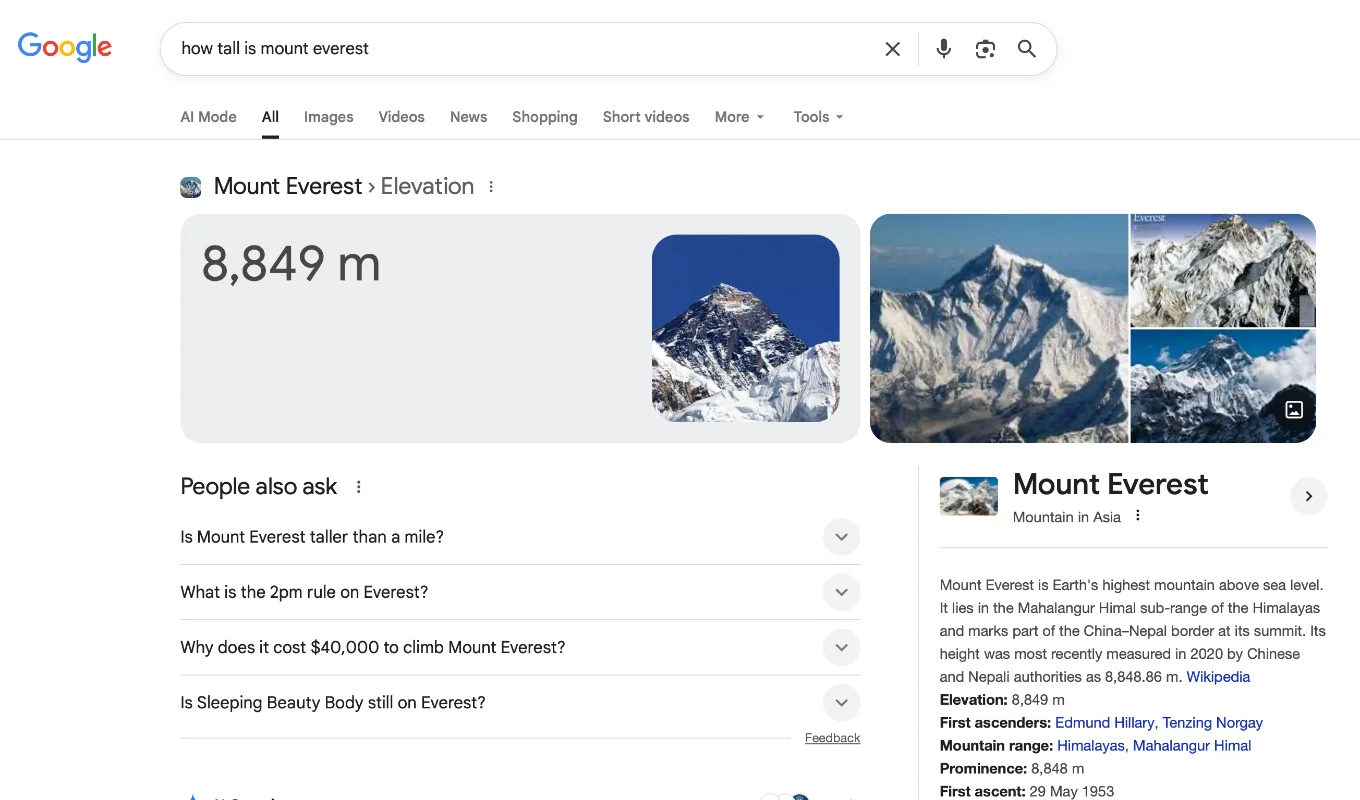
In Google’s AI Mode – where it generates a comprehensive answer instead of a list of links – fewer than 4% of users click through to an external site.
That last one is worth sitting with. 96 out of 100 people get their answer and move on without visiting anyone’s website.
And here’s the number that reframes all of it: visitors who arrive from AI search convert 4.4 times better than traditional organic traffic. Less traffic, but the traffic that does come is far more ready to act.
The search game has changed. The businesses adapting now will be well-positioned. The ones waiting are building a problem.
What's actually changed
Traditional SEO meant choosing keywords, building pages around them, and collecting links. The search engine presented ten results, users clicked through.
AI search works differently. Instead of presenting options, it gives an answer – often with no clicks at all. You’re no longer just competing to be in the top ten results. You’re competing to be cited, quoted, or recommended by the AI itself.
This isn’t only happening on Google. Microsoft’s Copilot, ChatGPT Search, Claude and Perplexity are all answering questions your potential customers ask daily. If you want to appear in those answers, your website needs to be findable by Bing as well as Google – which means setting up in Bing Webmaster Tools, something a huge number of businesses have never done.
Sundar Pichai, Google’s CEO, has said search will be “more ambiently available to users in radically different ways” over the next decade. That direction of travel is already visible. The only question is whether your website is ready for it.
The old playbook is dead
Keyword stuffing was the first thing to go. Forcing the same phrase into every heading and paragraph signals low quality to modern algorithms – it doesn’t help.
Backlink quantity over quality stopped working too. A thousand links from irrelevant or low-authority sites does nothing meaningful. A handful of genuine links from respected sources in your sector still matters a great deal.
Thin content at scale was wiped out. Google’s Helpful Content Update eliminated around 45% of low-quality content sites – pages that were technically optimised but genuinely unhelpful to the people reading them. These weren’t fringe black-hat tactics. They were standard practice for a lot of businesses.
Here’s the uncomfortable truth behind all of this: Google’s ranking systems are no longer hand-written rules that can be gamed. They’re AI systems that learn and adapt, and they’re getting better at telling the difference between content that genuinely helps people and content that exists purely to rank.
Ranking at number one on Google no longer guarantees visibility either. 60% of AI Overviews on mobile completely ignore the top organic result. Your position in traditional search and your presence in AI-generated answers are increasingly separate problems.
Search intent has changed
When someone searched “walking boots” in 2015, they got a list of results for walking boots. Now someone might ask “what are the best men’s size 10 waterproof walking boots for winter hill walking?” – and expect a proper, specific answer rather than a list of pages to sift through.
Your content needs to be built around how people actually ask questions, not just which keywords they use. There are four types of search intent:
Informational – they want to understand something. “What is schema markup?” or “how does page speed affect rankings?”
Navigational – they want to reach a specific place. “Google Search Console login” or “fecking creative web design.”
Transactional – they want to buy or hire. “Hire a web designer Carlisle” or “book an SEO consultation.”
Commercial – they’re researching before committing. “Best web designer Cumbria” or “Wix vs WordPress for small businesses.”
Getting intent wrong is expensive. A blog post trying to rank for a transactional query, or a service page competing for an informational one, will underperform no matter how technically solid it is.
The quiet leaks most businesses don't notice
The problem most websites have isn’t that SEO is dead. It’s that they’re losing the right visitors quietly at every step, long before rankings become the issue.
Written for everyone, connecting with no one. If your website could belong to any business in your sector, it belongs to none of them. Content that addresses the specific problems of the specific people you want to work with consistently outperforms generic copy trying to appeal to the broadest possible audience.
No clear next step for people who are ready. Someone who arrived via AI search and is ready to act shouldn’t have to hunt for a phone number or guess what happens when they fill in your contact form. If the warm, interested visitor has to work to get in touch, many won’t bother.
Social proof that’s invisible. Reviews exist but they’re buried on third-party platforms. Case studies are in a PDF nobody opens. Testimonials sit on an About page rarely visited. The best evidence you have needs to be where people actually look, in the flow of the pages they’re already on.
Content written for 2015, not 2026. Pages built around “best [service] in [city]” rather than “how much does [service] usually cost?” or “what should I ask before hiring a [service provider]?” are missing real queries and the real intent behind them.
These leaks mean search can deliver the right person to your site and they still leave without getting in touch. Fixing them matters more than chasing rankings.
What Google actually rewards
The Helpful Content Update made explicit what was always true: content created primarily for search engines rather than for people doesn’t win long-term.
The four questions Google effectively asks about your content:
- Is it genuinely relevant to your target audience – not just a topic you’re covering to attract traffic?
- Does it demonstrate real expertise or first-hand experience? Writing about products you haven’t used or topics outside your genuine knowledge is increasingly detectable.
- Does it thoroughly answer the question? After reading it, does someone have what they needed, or do they still need to search elsewhere?
- Is the overall experience good? Clear, readable, not cluttered with pop-ups or distractions?
If the honest answer to any of those is no, that content is either underperforming or dragging down everything else. Google treats helpful content as a site-wide signal – one substantial section of poor content can affect the whole domain’s rankings.
How to be found by AI, not just Google
Being cited by AI systems requires different signals to ranking in traditional search.
Structure content to be quotable. AI tools extract clearly articulated answers. Short paragraphs that stand alone, FAQ sections with specific questions and direct answers, simple comparison tables, glossary-style explanations — all of these are formats AI can pull from easily. Clever or vague section headings that obscure what a section covers work against you.
Show your expertise explicitly. Real author credentials, case studies from actual work, original observations rather than rehashed information, awards and certifications displayed where people can see them — all of this makes it easier for AI to treat your site as an authoritative source rather than passing over it.
Be consistent everywhere online. AI tools cross-reference multiple sources. Your business name, address, phone number, and services need to match across your website, Google Business Profile, and key directories. Conflicting information undermines trust — for AI systems as well as for humans, which connects directly back to the NAP consistency covered in the local SEO guide.
Implement schema markup. Structured data helps search engines and AI understand what your content is about. LocalBusiness, Article, FAQPage, and Service schema all make your content more legible to automated systems. This is no longer something to get around to eventually.
Build your brand in the places AI looks. Reviews, mentions in relevant publications, citations in other authoritative content — AI systems build authority assessments from these signals. A good website in isolation isn’t enough.
On using AI to create your content
Since we’re talking about AI: yes, you can use AI tools to help create content. Google has been clear that AI-written content is acceptable as long as it meets quality standards – genuinely helpful, demonstrates expertise, and has had real human judgement applied to it before it goes live.
The problem isn’t the tool. The problem is the approach. An AI can produce a 1,000-word article on any topic in seconds. That article, indistinguishable from ten others on the same topic, with no real expertise or original perspective, is exactly what the Helpful Content Update was designed to demote.
We ran a test of this ourselves – published a post created entirely by AI in under ten minutes, starting from three words. The result was readable, plausible, and almost completely worthless. We said so at the end of the post.
Use AI to research, to draft, to speed up the process. The expertise, the specific examples, the genuine point of view – those need to come from you. An AI can write about your services. It cannot replicate why a client chose you over a competitor, what you noticed on a project that surprised you, or the real answer to the question your customers ask most often. That’s the content that gets cited. That’s the content that converts.
Your action list
Test your AI visibility now. Open ChatGPT, Perplexity, and Google with AI Mode enabled. Search for the questions your customers ask. Are you mentioned? How do you compare to competitors? This takes twenty minutes and tells you a great deal.
Audit your content against the four questions above. Any page that fails on more than one needs to be rewritten, edited, or removed.
Fix your structure. Add FAQ sections to key pages. Use clear, descriptive headings. Make each paragraph capable of standing alone as a quotable answer.
Make your expertise visible. Add real author information. Include genuine case studies. Cite your sources. Put your proof where people actually look.
Sort your schema. Start with Organisation and LocalBusiness schema, then move to Article and FAQPage on relevant content.
Tighten your citations. Business name, address, and phone need to match everywhere. Get your Google Business Profile current and active. These fundamentals matter more now, not less.
What to expect
For less competitive terms and local searches, early movement is possible in one to three months. Meaningful traffic increases typically take three to six months. Substantial gains for competitive terms take six to twelve months or more.
AI search is newer territory and timelines are less established, but the compound effect is real. Businesses that establish themselves as AI-cited authorities now will benefit from that for years. The window before most competitors take this seriously is measured in months, not years.
By some projections, AI search will drive more traffic than traditional search by 2028. If Google makes AI Mode the default, that could happen considerably sooner. Getting the foundations right is not a future problem.
SEO and AI visibility are core to what we do at fecking creative. If you want to understand where your site currently sits, and what it would take to become the obvious answer in your area and sector, requesting your AI Readiness Report is the perfect place to start. Or get in touch directly.