
By Stephen Little, owner of fecking creative – 18+ years in UK search and web design. Originally published July 2017, last refreshed January 2025, rewritten May 2026.
I get this question every week. Usually it arrives in the same shape: “We’re thinking about SEO – what’s a reasonable budget?” My answer never lands cleanly because the honest reply is “it depends” and nobody likes that answer.
This rewrite gives you the version I wish I could send instead. The current UK SEO Pricing ranges (in pounds, sourced from the most recent surveys), what each spend band actually buys you, why agencies cost more than freelancers, when an hourly rate is fine and when a retainer makes more sense. I’ve cited every source so you can check the numbers for yourself.
TL;DR
- UK SEO retainers for small businesses in 2026 typically run £500–£2,500/month, with meaningful results usually starting at £1,000–£1,500/month (Whitehat SEO, 2026; Media Village, 2026).
- Local SEO for a single-location small business starts at £300–£500/month (Targeted SEO, 2026).
- UK freelancer hourly rates sit at £40–£100/hour; UK agency consultant rates run £70–£300/hour, with London strategic specialists at £250–£400+/hour (Freelance Rate Calculator UK, 2026; The Nurtur, 2026).
- Globally, the Ahrefs survey of 439 SEOs (Aug 2024) puts the average monthly retainer at $2,917, with agencies at $3,209, consultants at $3,250, and freelancers at $1,348. Backlinko’s 2026 update (300+ SEOs, Dec 2025) puts the typical retainer range at $1,000–$2,500/month.
- 78.2% of SEOs price as a monthly retainer (Ahrefs, 2024). Hourly and project pricing exist but are minority models.
- Agencies charge 138% more than freelancers on average. You’re paying for breadth of skills, accountability, and the safety of a team that survives one person leaving.
- What £X/month actually buys you (tier table below): £500 = local SEO basics; £1,500 = real growth retainer; £3,000 = competitive industry retainer; £5,000+ = enterprise/competitive vertical.
- Red flags: anything under £300/month, anyone who promises guaranteed rankings, anyone who quotes by hours without quoting by outcomes.
The honest short answer
If you run a UK small business and want a meaningful, retained SEO engagement that lifts traffic and enquiries over a 6–12 month window, budget £1,000–£2,500 per month. That’s the band where most UK agencies and senior freelancers can do enough work each month for the results to compound.
If you’re a local one-location business with modest competition (a single dental practice, a salon, a tradesperson), you can get real value from £500–£1,000/month focused on Google Business Profile, local citations, and a handful of service pages.
If you’re in a competitive vertical (finance, legal, e-commerce, multi-location, national), budget £2,500–£5,000+/month.
Below £500/month, you’re almost always buying either automated work that won’t move the needle or a freelancer’s marginal hour at a discount that won’t be sustainable. Below £300/month, you’re buying problems.
The rest of this post explains why those numbers look the way they do.
What pushes SEO pricing up or down
The same eight factors come up in every pricing conversation I have. They’re listed in roughly the order they affect the final number.
1. Who’s doing the work
A senior UK SEO consultant with 10+ years’ experience charges 3–4x what a junior freelancer charges. They’re worth it for complex sites, competitive industries, and anything where a mistake (a botched migration, a bad redirect plan, a thin-content rollout) costs more than the agency’s annual fee.
A junior freelancer is fine for a small site in an uncompetitive niche where the job is mainly executing a clear plan. The risk: less experience means fewer “we tried that in 2019 and it didn’t work” instincts.
Backlinko’s 2026 data shows entry-level UK rates around £35-40/hour, mid-level £60-75/hour, senior level £100-130/hour, and expert-level £150-180/hour.
2. Agency, consultant or freelancer
Three different cost structures.
- Agency – team of specialists. Higher cost. Survives one person quitting. Includes strategy, technical, content, and reporting under one roof.
- Consultant – usually a senior solo operator. Higher hourly rate than a freelancer but typically deeper expertise. Best for strategy work or hard problems.
- Freelancer – one person doing the work. Lowest cost. Risk: bus factor of one, and skill gaps in whichever specialism isn’t their strongest.
The Ahrefs survey found agencies charge 138% more than freelancers on average – $3,209/month vs $1,348/month. Consultants charge $3,250/month, the highest tier of the three.
3. Where they’re based
UK pricing scales roughly with cost of doing business. A London-based agency charging £300/hour isn’t gouging – their office rent and senior staff salaries justify it. A Manchester, Leeds, or Birmingham agency offering similar work for £150-200/hour is typical. Outside the major cities, £100/hour for senior work is normal.
Don’t reflexively choose the cheapest geography. A regional agency that genuinely understands your sector beats a London agency working on you between two larger clients. Pick on fit and track record, not on postcode.
4. Pricing model
UK SEO firms use four common pricing structures.
- Monthly retainer – ~78% of the market (Ahrefs, 2024). Steady work, compounding results. Best for ongoing engagements.
- Hourly rate – best for one-off projects, consultancy, or specific tasks (a migration plan, a technical audit, a content review).
- Fixed project fee – a one-off SEO audit, a site migration, a content gap analysis. Agency average around $9,500/project, freelancer average around $2,350/project (Ahrefs, 2024).
- Pay-on-results – uncommon, and for good reason. Everyone who’s offered it to a client of mine has had a catch buried somewhere in the small print. Treat with care.
5. Size of your business
A single-location plumber needs less SEO work than a 14-branch dental group. A 50-product Shopify store needs less than a 5,000-product B2B catalogue. Scope drives hours, and hours drive cost.
6. How competitive your industry is
“Solicitor London” and “personal injury lawyer Manchester” are nuclear-level competitive. So is “online casino”, “mortgages”, “VPN”, and anything in finance. If you’re in one of those, expect to spend £3,000-£5,000/month minimum and to wait 9-12 months for meaningful movement.
“Wedding cake maker Cambridge” or “drystone waller Cumbria” are much gentler. £500-£1,000/month can move you significantly inside six months.
7. The state your site is in now
A clean, fast, well-structured site needs less remedial work than a Wix-on-a-Wednesday job from 2018 with broken redirects, duplicated pages, and a Core Web Vitals score of 22. The worse the starting position, the higher the first 3-6 months of cost (the technical fixes), then the retainer settles to a normal monthly figure once the foundations are sound.
8. What “done” looks like
“Outrank a category-leading national brand for a head term” is a different brief from “lift enquiries on our service pages 20%”. The first might take three years and £5k/month. The second might take six months and £1,500/month. The clearer your goal, the more accurately anyone can price it.
UK SEO pricing in 2026 - the numbers
Pricing data sourced from the most recent UK-specific surveys and listings.
Monthly retainers (UK, GBP)
| Tier | Monthly price | Typical client | Source |
|---|---|---|---|
| Local SEO starter | £300–£500 | Single-location small business | Targeted SEO, 2026 |
| Small business | £500–£1,000 | Established local business, modest competition | Media Village, 2026 |
| Growth retainer | £1,000–£2,500 | SME, meaningful results expected | Whitehat SEO, 2026 |
| B2B SME strategic | £2,500–£5,000 | B2B SME, 30–50 strategic hours/month | Whito, 2026 |
| Enterprise / competitive | £5,000+ | National brand, competitive vertical | Multiple UK agencies, 2026 |
Hourly rates (UK, GBP)
| Tier | Hourly rate | Source |
|---|---|---|
| UK freelancer general | £40–£100 | Freelance Rate Calculator UK, 2026 |
| Junior SEO | £30–£50 | The Nurtur, 2026 |
| Senior SEO strategist | £100–£200 | The Nurtur, 2026 |
| UK agency consultant | £70–£300 | The Nurtur, 2026 |
| London strategic specialist | £250–£400+ | The Nurtur, 2026 |
Global benchmarks (USD, for context)
The two largest recent global surveys land on slightly different averages depending on when they polled.
Ahrefs polled 439 SEO service providers in August 2024:
- $2,917/month – overall average monthly retainer
- $3,209/month – agency average
- $3,250/month – consultant average
- $1,348/month – freelancer average
- $1,557/month – local SEO retainer average
- $501–$1,000/month – single most common retainer band (20.4% of respondents)
- $111/hour – overall hourly average
- $71.59/hour – freelancer hourly average
- $98.90/hour – agency hourly average
- $171.18/hour – consultant hourly average
- 78.2% of SEOs use monthly retainer pricing
- Agencies charge 138% more than freelancers on average
Backlinko’s December 2025 update, based on 300+ SEO professionals:
- $1,000–$2,500/month – typical retainer range
- $45/hour (entry), $75/hour (mid), $130/hour (senior), $180/hour (expert) in the US, UK, and Australia
- $1,000–$5,000/project – typical project-based range
The two surveys disagree on the average, partly because Ahrefs includes the high-end consultants who push the mean up. The honest read: most SMEs pay £1,000–£2,500/month, and the loud tail at the top of the market pulls global averages higher.
What £X a month actually gets you
The single most useful table I can put on this page. Approximate scope by retainer band. Real engagements vary, but this is what I’d typically expect at each tier for a UK SME.
| Spend | What it typically buys (per month) |
|---|---|
| £300–£500 | Local SEO basics. Google Business Profile optimisation, citation cleanup, 1–2 short blog posts or a service-page tweak, basic monthly reporting. Best for: a single-location small business with low competition. |
| £500–£1,000 | Local + a bit of content. GBP optimisation, 2–3 blog posts or service pages, light technical fixes, basic keyword tracking, monthly call. Best for: a small business that wants more than the minimum but isn’t ready for full growth investment. |
| £1,000–£2,500 | Real growth retainer. Strategy, 3–5 content pieces, ongoing technical fixes, on-page optimisation across 5–10 priority pages, link-building outreach, GBP work, monthly strategy call, real reporting tied to enquiries (not just rankings). Best for: an SME serious about lifting traffic and enquiries inside 6–12 months. |
| £2,500–£5,000 | B2B SME strategic tier. 30–50 hours/month. Senior strategy, technical SEO at depth, 5–10 content pieces, link-building campaigns with measurable outreach, AI search / answer engine optimisation, conversion rate work tied to traffic gains. Best for: B2B SMEs in moderate-to-competitive verticals. |
| £5,000+ | Enterprise or competitive vertical. Multi-specialist team, international or multi-location work, full content engine, digital PR, advanced technical, dedicated account lead. Best for: national brands, competitive industries (finance, legal, healthcare, e-commerce at scale). |
The biggest mistake at the lower end is expecting a £500/month engagement to deliver £2,500/month-tier outcomes. The output scales with the input. Set expectations against the band you’re buying.
A first-person mistake worth admitting
For roughly the first decade I ran fecking creative, back when it was called Compute, I quoted SEO by hours. So many hours per month, this is what they buy you, here’s the proposal. It looked transparent. The clients who paid me the most always wanted to talk about hours – “what did the 20 hours go on this month?” – and they were the clients who tended not to renew.
The clients who got the best results, year after year, never once asked me about hours. They wanted outcomes – page-1 rankings on the queries that bring buyers, enquiry growth, traffic from AI search citations. Hours were my problem, not theirs.
I caught the mistake properly in 2022 after losing a renewal with a client who’d had brilliant results because, in his words, “I can’t justify £1k a month if I can’t tell my partner what we actually got for it.” We’d produced everything in the proposal, hit every target, lifted his enquiries 65% – but I’d never reframed the conversation from hours to outcomes. He left. I deserved it.
Since then, every fecking creative SEO proposal is built around outcomes, and on a Monthly Retainer – specific traffic and enquiry targets, with the work plan attached as supporting detail rather than as the headline. Win rate went up. Retention went up. The hours haven’t changed; the framing did. If you’re a small business owner reading an SEO proposal and the headline is “20 hours/month for £1,500”, ask the agency what those 20 hours are for. The good ones can answer in outcomes. The bad ones can only answer in tasks.
Red flags - when “too cheap” is a warning
The dangerous price isn’t the high one. It’s the low one that promises everything.
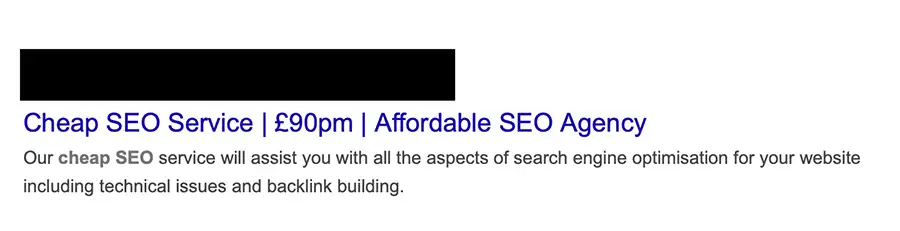
Anything under £300/month with a list of services as long as a £1,500 retainer. The maths doesn’t work. Either the work is automated (Bot-generated content, mass-produced citations, link-farm placements – all of which damage your site), or the agency is loss-leading you into a contract that gets neglected.
“Guaranteed page 1 in 30 days.” Nobody can guarantee rankings. Anyone who claims they can is either lying, hiding what they’re doing (often black-hat techniques that get sites penalised), or planning to rank you for queries nobody searches.
Massive monthly link volumes for low prices. “100 backlinks a month for £200” means private blog networks, link farms, or paid placements that Google sees through within months. The recovery cost when those links get spotted is several multiples of what you saved.
No reporting on enquiries or revenue, only rankings. Rankings on the wrong queries are decoration. A good SEO retainer reports on the queries that bring buyers, the enquiries those queries produced, and the conversion rate from enquiry to contract.
No named consultant on your account. Big agency, three-tier support team, nobody who actually knows your business. The retainer becomes invoice-and-spreadsheet, not strategy.
Heavy use of “we” without specifics. Look at the proposal. If it could be sent to any business in any sector with the company name swapped, that’s how the work will be done too.
Is SEO worth the money in 2026?
Different question now than it was in 2017. Then, SEO was straightforwardly the highest-leverage marketing channel for most UK SMEs. Now, organic clicks are down 25–40% on 2022 levels across the small business sites I work with, mostly because AI Overviews, ChatGPT, Perplexity, and Gemini are answering questions directly without a click. I wrote about that shift at length in Your Website Traffic Is About to Die and the companion piece What Are Zero-Click Searches?.
So is SEO still worth it? Yes, but the brief has changed.
The 2017 brief was “rank well in Google so people click through to your site”. The 2026 brief is “rank well and get your brand cited by AI tools and convert the clicks you do receive at a higher rate”. The work has broadened. The price hasn’t moved proportionally, which is actually good news — the same £1,500/month now buys you classic SEO plus answer engine optimisation plus (in most engagements) conversion rate help. We covered the AI side at length in From Search Engine to Answer Engine and the conversion side in What is Conversion Rate Optimisation?.
The businesses that drop SEO in 2026 because “AI is killing organic” are making the same mistake they’d have made in 2008 by dropping search because “social media is killing it”. Organic search isn’t dying – it’s broadening into AI search, and the businesses who keep showing up in both classic Google and AI answers are the ones winning the next decade.
Frequently Asked Questions
How much does SEO cost in the UK for a small business?
Most UK small businesses pay £500–£2,500 per month, with £1,000–£1,500/month being the typical “meaningful results” tier. Local SEO for single-location businesses can be done well from £300–£500/month. Below £300/month, you’re almost always buying automated work that risks harming your rankings.
How long does SEO take to pay back?
4–6 months for meaningful traffic lift; 9–12 months for revenue payback in most cases. SEO compounds, so the second year typically delivers 2–3x what the first year did at the same monthly spend.
Is a monthly retainer better than hourly?
For ongoing work, yes. Retainers smooth out the workload, build accountability over time, and let the SEO team plan campaigns properly. Hourly billing is better for specific one-off projects (audits, migrations, consultancy calls) where the scope is contained.
Are SEO guarantees legitimate?
No. Nobody can guarantee rankings – Google’s algorithm changes too often and the competitive landscape is too dynamic. Anyone offering guaranteed page-1 rankings is either using techniques that will get you penalised or guaranteeing rankings on queries nobody searches.
The 2026 takeaway
SEO pricing in the UK in 2026 is roughly where it’s been since 2022 – £500/month at the local-business floor, £1,000–£2,500/month for serious growth retainers, £2,500–£5,000+ for B2B SMEs and competitive industries. What’s changed is what that money buys: classic SEO plus answer engine optimisation plus AI citation work, plus (in most decent engagements) conversion help on the pages where the new traffic lands.
The biggest unforced error UK small businesses make on SEO pricing is buying the cheapest quote. Every penalised site, mass-content disaster, and PBN-link cleanup I’ve done since 2017 traced back to a “£199/month all-in” promise. The recovery cost in every case was at least 5x what the client thought they’d saved.
The second biggest error: paying mid-tier prices and expecting top-tier outcomes. A £1,500/month retainer can do real growth work. It can’t, in 12 months, take you from page 5 to page 1 in a competitive vertical with a national brand on every other position. Match the band to the brief, set realistic 6–12 month targets, and measure against enquiries not rankings.
If you’d like an honest conversation about what your situation actually needs – and a quote built around outcomes rather than hours – Contact us. We’ll tell you the truth even when the truth is “you don’t need us yet”.